Your Part Looks Wider in Every Photo. Here Is What Is Happening at Your Follicles, and Why Volume Shampoo Cannot Fix It.

You have tried the volume shampoo, the root lift and the side part, and you still zoom in on your scalp.

The problem is not on the surface. It is at the follicle, and until recently nothing you could buy reached it. Here is what is going on, and what does.

A woman at her kitchen table looking at a group photo on her phone, her parting visible from above

You noticed your wider part in a photo

Someone sends the pictures from the weekend. You open the group chat, tap through a few, and stop on one taken from a little above you.

Everyone else is looking at the smiles. You're looking at the pale line through the top of your hair.

You pinch the screen to make it bigger, then pull it back again. That part looks wider than it does in the mirror. Or maybe you just haven't seen it from that angle before.

So you go looking for another photo.

A woman in bed at night, the phone screen lighting her face as she scrolls through old photos

There are plenty of pictures on your phone, but finding the right one is harder than it should be. Your hair was curled in that one. The next was taken outside. In another, your part is on the other side and the top of your head is cut off.

You keep scrolling anyway, because you want one clear answer before you put the phone down.

By the next morning, the question has followed you into the bathroom. You move your part with the end of a comb, lean toward the mirror and try to see the top of your head. Then you hold your phone above it and take a picture.

Now you have another photo to inspect.

A few days ago, getting ready meant doing your hair. Today, a good part of it is checking your scalp.

Checking your scalp becomes part of your day

At first, a small change in how you style it seems like enough. A side part covers the spot. A little lift at the roots makes the line less clear.

You leave the house feeling better, until you catch yourself in a mirror with a light right above it. The question comes back, and you start turning your head to see whether the light is making it worse.

A woman moving her parting with the tail of a comb in the bathroom mirror, her phone on the counter

If that sounds familiar, you may also know the awkward part about bringing it up.

You don't want a friend to lean in and inspect your head. You don't want to be told you're worrying over nothing when you've already spent half an hour looking through old photos. But you would love someone to give you a clear answer.

So the search stays private for a while.

You look at brushes, shampoo bottles and advice about changing your part. A woman in a video says one thing helped her. In the comments, someone else says it did nothing. Soon you're comparing products for a problem you still aren't sure how to describe.

You weren't looking for a whole new hair routine. You wanted to like the next photo without zooming in on your scalp.

That is a reasonable place to start. The next step is to separate the things you can change when you style your hair from the things that happen where it grows.

Styling changes how your hair sits, not what happens at the follicle

FIGURE · WHERE EACH ROUTE ACTS

Styling

  • Lift at the roots
  • Moving the part
  • A different cut
  • Where the hair grows

Scalp care

  • Lift at the roots
  • Moving the part
  • A different cut
  • Where the hair grows

There is a reason a good blow-dry can change how you feel about your hair.

Lift at the roots changes the way the strands sit. Moving the part changes how much scalp shows in one line. A different cut can change the shape of the whole style.

Those are useful tools. If a side part helps you get on with your morning, there's no reason to stop wearing one.

The difficulty comes when you expect that change in appearance to answer a different question: what is happening where the hair grows?

A style that looks fuller today can't tell you why your part seems different. Nor can the number of hairs you happen to notice on one wash day.

That gap is where buying another bottle becomes tempting. The front says volume or thickness, which sounds close to what you want. You take it home hoping it will also settle the question that started with the photo.

Before you build a shelf around that hope, look at what each product is actually for.

A styling product helps the hair you see sit differently. A scalp product is used on the skin where the hair grows. A treatment for a medical cause is a separate choice. Understanding those jobs makes the search much easier to follow.

A small bathroom shelf crowded with half-used haircare bottles, a brush and a wide-tooth comb

One photo cannot tell you why your part looks wider

Even two pictures taken a week apart can look quite different.

Wet hair can lie together in ways that show more scalp. A bright ceiling light can make a part stand out. Moving the camera a few inches changes what it captures.

That doesn't mean you should brush off a change you've noticed. It means an old holiday photo and a new bathroom selfie are a poor way to measure it.

If the change keeps showing up, a dermatologist can help you find the cause. A sudden change, new bald patches or a sore scalp deserves a check before you add a product.

A woman at a dressing table with a phone on a stand pointing down at her parting

For your own record, a simple photo you can repeat is more useful than another hour of scrolling.

Choose one parting and one place with even light. Keep the camera at the same distance each time and leave styling products out of the shot. Save the date with the picture.

You now have something you can come back to. That matters whether you decide to try scalp care, seek treatment or ask for help before choosing either.

Your hair grows from follicles that run on protein signals

Each hair grows from a small structure in your scalp called a follicle. That is where the growth process takes place, beneath the part you brush and style.

Hair also moves through a cycle. There is a growing phase and a resting phase, and hairs shed as that cycle continues.

Cells involved in the process use signals to communicate. Some of those signals are proteins called growth factors.

A follicle in cross-section with two small protein shapes beside the bulb

The name can sound like a claim on a bottle, so it helps to be clear about what it means. Growth factors are a group of proteins studied for the jobs they do in cell biology. Two involved in hair biology are called FGF·2 and FGF·7.

Those names are useful when you get to a label. For now, the point is that hair care can be built around more than changing how a strand feels or sits.

These proteins have been studied in scalp serums. But putting them in a bottle raises a question of its own. How do you keep a fragile protein intact until it's time to use it?

The answer turns out to be a large part of the story.

FIGURE · THE HAIR CYCLE

Growing phase

Resting phase

Sheds

Growth factor proteins break down in an ordinary serum

A protein has a shape, and that shape matters to the job it does.

That is easy to miss when you read a label. An ingredient name looks fixed and solid in print. Inside a water-based formula, a fragile protein has to hold its structure through storage and use.

If it loses that structure, the name on the label hasn't changed. The state of the protein has.

This is why putting a growth factor into a serum is only part of the work. The formula also needs a way to protect it.

A protein anchored to a plant oil body, beside the same protein unravelled without it

Think of a folded paper shape. The folds are part of what makes it work as a shape; the fact that it is still made of paper tells you very little if those folds are gone. Proteins are far more complex, but the basic point is the same: structure matters.

For someone choosing a scalp serum, that makes the carrier worth understanding.

You can ask which growth factor is in the bottle. You can also ask how it is kept intact. A product that explains both gives you more to assess than an ingredient name by itself.

Plant oil bodies keep the proteins intact in the bottle

Plants contain tiny oil bodies called oleosomes. In this approach, a growth factor is joined to one of those bodies.

The oil body acts as a carrier, helping keep the protein intact in the formula. The protein and its carrier form one joined structure.

You don't have to remember the word oleosome to see why that matters. The tiny oil body helps protect the protein while it sits in the bottle.

It also gives you a better way to read the growth-factor story.

FIGURE · PROTEIN STRUCTURE OVER TIME

↑ Protein structure intact

With the oil-body carrier Unprotected
FilledIn your bathroom

The presence of a protein and the protection of that protein are two separate things to check. Evidence about the formula or active is a third. One doesn't stand in for the others.

A protected ingredient still needs research. A study still needs to tell you what was tested. And a finished routine still needs to be something you can use as directed.

Put those pieces together and a new scalp-care approach starts to become clear. You can understand how it was built before being asked to judge it by a photo or a promise.

OF·27 puts protected growth factors in a scalp serum

OF·27 uses forms of FGF·2 and FGF·7 joined to plant oil bodies in its Follicular Serum.

You use it on your scalp for fuller-looking hair. It is a non-hormonal cosmetic. Both proteins are joined to carriers that keep them intact in the bottle, and both amounts are printed on the label: 100 and 500 ng/mL.

That gives the serum a specific place in a routine. It is the leave-on step used where your hair grows.

The OF·27 Advanced Protocol: two Follicular Serum bottles and the Scalp Reset Serum

The second step, called Scalp Reset, has a different job. You use it once or twice a week to clear buildup and excess oil, then rinse it away.

The two steps start together. There is no first stage in which you spend weeks using only the rinse and wait to start the serum. From the start, one step rinses off and the other stays on.

This is also where it makes sense to slow down and check the evidence.

Knowing how a serum is built is useful. Before you spend money, check what was tested and what the study found.

A woman at her bathroom sink in the morning, two small serum bottles on the edge of the sink beside her

In the 12-week study, hair density rose 33.5%

The study behind this approach enrolled 40 women with a type of shedding called telogen effluvium.

Half used a serum with the FGF·2 active. The other half used the same base without the active. The women did not know which one they had, and they used it for 12 weeks. An independent laboratory, Abich S.r.l. in Italy, measured hair density with a phototrichogram at set points during the study.

Two identical unlabeled serum bottles side by side, indistinguishable from one another

At week 12, average hair density in the active group was 33.5% above where that group had started. The group using the base alone showed a 7.2% rise from its starting point. 90% of the women using the active improved on the clinical density score; on the base alone, 35% did.

The study tested the active in women with shedding-prone hair, and the active's maker funded it. Your own two photos are the comparison that counts for you.

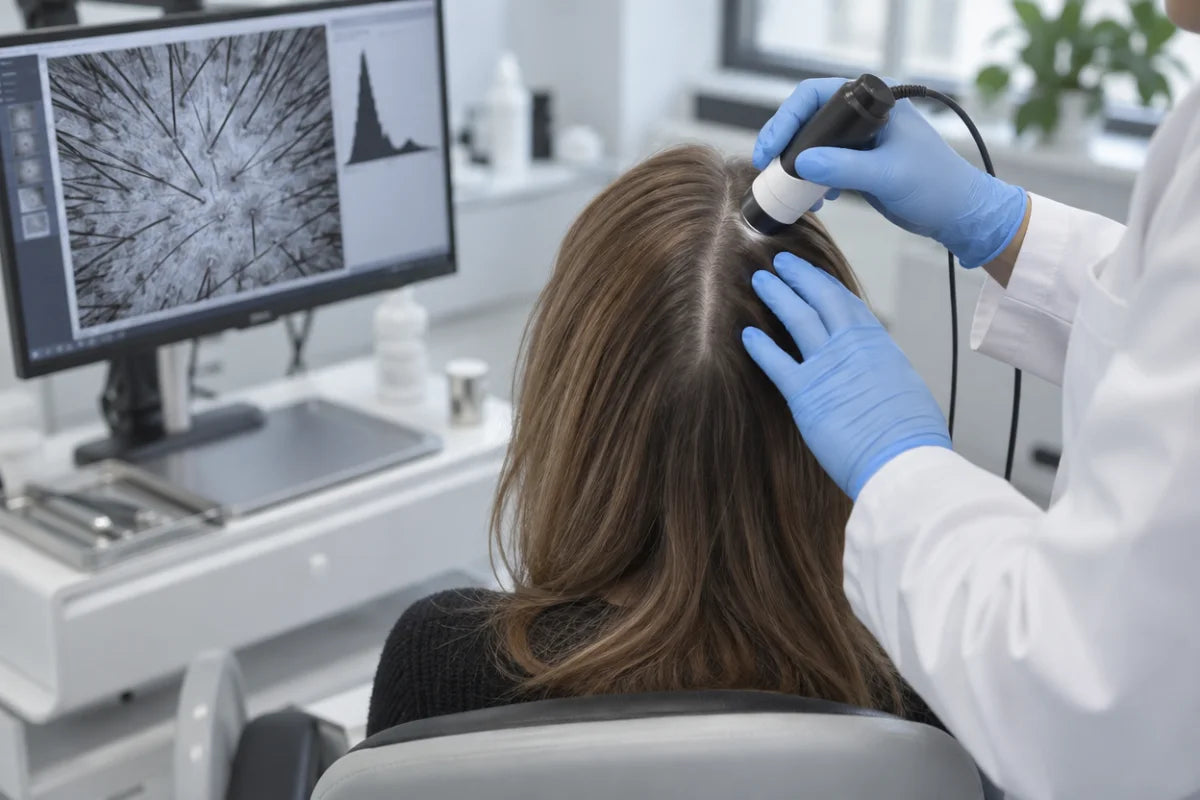
A technician scanning a woman's parting with a trichoscope camera, the follicle image on the screen
Used the active for 12 weeks
0%
Used the base alone
0%
Hair density, active group
+33.5%
Hair density, base alone
+7.2%
Follicles in the growth phase
+17.0%
Strand thickness
+10.6%
Abich S.r.l., independent laboratory· randomised, placebo-controlled, 84 days, published 2026

The routine: one pump a night, one rinse a week

A routine is easy to picture when you're reading about it. The useful test is how it fits on a night when you're tired and still have things to do.

With OF·27, the nightly step is one pump of Follicular Serum. Massage it into a clean, towel-dried scalp for at least 30 seconds, then leave it on overnight.

Once or twice a week, use Scalp Reset on a dry scalp. Leave it for three to five minutes, then rinse it out. The serum is still part of your nightly routine on those weeks.

A woman at the edge of her bed at night massaging one pump of serum into her parting

Each Follicular Serum bottle covers six weeks. The full course includes two, so the second bottle takes you through week 12.

There is also a storage detail to plan for. Keep the serum in the fridge, between 2 and 8°C, to preserve the proteins. Do not freeze a bottle or use one that has frozen.

That is the routine you are choosing: a nightly step, a weekly rinse and a place to keep the serum cold. The written guide comes with the course, so you have the steps in one place when the bottles arrive.

See the full routine on the product page

FIGURE · THE NIGHTLY ROUTINE

NIGHTLY

One pump, massaged in

1-2X A WEEK

Scalp Reset, 3 to 5 min

ALWAYS

Kept in the fridge, 2 to 8°C

Take your first photo on day one

The photo that brought you here was hard to judge because you had nothing quite like it to compare it with.

A planned course gives you a chance to do that part differently.

NotesPhoto plan

My 12 weeks

  • Day 1: photo of my part. Same lamp, same distance, no product
  • Email it to OF·27 within 7 days of delivery
  • Every night: one pump
  • Once a week: Scalp Reset, 3 to 5 minutes, rinse
  • Week 7: open bottle two
  • Week 12: same photo, same lamp. Put them side by side
A woman at her bathroom counter opening a second serum bottle from its box

Take your first photo at the start. Use the same parting, light and camera distance at week 12, with no styling products in either shot. For the results guarantee, email that first photo within seven days of delivery.

Then follow the routine through the full 12 weeks. Weeks one to six use the first bottle along with the scalp rinse. When that bottle is finished, the second carries the nightly step through weeks seven to twelve.

At the end, take the second photo under the same conditions. You have a planned point to review what changed, instead of relying on how your hair happened to look on a good or bad morning. It also gives you the photos required for a guarantee claim.

What you know now, and what to do next

Go back to the group photo for a moment.

You wanted to look at it and remember the day. You wanted getting ready to take the time it used to take. A good hair day meant liking how your hair looked, then giving your attention to something else.

That is why the details of a routine matter. They help you choose a next step without asking a new bottle to answer every question at once.

See the 12-week protocol

You now know what the serum contains, why the carriers are there and what was studied. You also know the daily steps and when to take the second photo.

OF·27 gives you a defined way to try that approach. The course lasts 12 weeks, comes in one order and includes a results guarantee with clear photo and use terms. If that fits what you've been looking for, the 12-week protocol is one step away below.

What one customer saw at week 12

Janis P.· Week 12Verified customer
I took photographs before starting and again at the end. Day to day, the changes were gradual, but the side-by-side comparison showed a real difference. My parting looks narrower, the scalp is less visible, and the hair along the front looks fuller. It is not an overnight transformation, but the progress is more noticeable than I initially realised.
Advanced Protocol · pre-order

Fuller-looking hair in 12 weeks.

One pump a night. +33.5% hair density in the 12-week study of the active.

  • 2 Follicular Serums, the full 12 weeks
  • Scalp Reset Serum, the weekly prepIncluded
  • The written guide, emailed todayIncluded
See the 12-week protocol

Next batch ships mid-October and it's already:

100%88% SOLD OUT
Don't see a difference at 12 weeks? Your money back.
MONEY BACK · 12 WEEKS · MONEY BACK · 12 WEEKS ·12WEEKS
Results guarantee

See a difference in 12 weeks, or your money back.

Use the Advanced Protocol every night for 12 weeks. Take a photo of your parting when the box arrives and another at week 12. If you can't see a difference between the two, we refund you.

1Photo of your parting when the box arrives
2One pump every night, Scalp Reset once a week
3Same photo at week 12. Send us both
Advanced Protocol. Claims accepted between week 12 and week 14. We refund the product price. Refund policy

Common questions

Does a wider part mean I need this product?

A photo alone can't tell you what your hair needs. If a change persists, a dermatologist can check the cause. OF·27 is cosmetic scalp care for fuller-looking hair.

Will my results match the study?

Results differ from person to person. The study tested the FGF·2 active in 40 women with shedding-prone hair. Your day-one and week-12 photos tell you what it did for you.

Can I use it with a treatment I already have?

Ask your prescriber before adding it, and keep using prescribed treatment as directed while you check.

Can a non-hormonal serum still irritate my scalp?

Yes. Stop use if your scalp becomes red, sore or itchy, and email OF·27. Ask your doctor before starting if you have a scalp condition or are unsure about an ingredient.

What happens after the 12 weeks?

Compare your matched photos and review what changed. Your order will not renew; if you choose to continue, one bottle covers six weeks.

Can I buy one bottle first?

The Standard Protocol is $175 for six weeks and does not include the results guarantee. The Advanced Protocol is the full 12-week course with two bottles, Scalp Reset and the guide.