Your Hair Serum Was Dead Before It Reached Your Scalp

There's one detail about thinning hair that almost no one talks about. And it deserves to be stated plainly — because you're not failing at hair care. The products you've used are failing at delivery.
You notice the shower drain first. Then the mirror. Then the photographs from two years ago.
The strands are finer. Less coverage where it matters. The scalp shows through in places it never used to.
So you try what the internet recommends: biotin and collagen shampoos. Repairing treatments. Minoxidil foam. Scalp serums with growth factors on the label.
But each one treats a downstream symptom. None of them fix the root cause: the growth signal that tells a dormant follicle to wake up isn't reaching the follicle intact.
After three to six months of doing everything right, most people land in the same place. The numbers on the label don't match what you see in the mirror.
It's not because the molecule failed. It's because the molecule never arrived.
The active ingredient degraded before it ever reached the follicle.
You blamed the product. Then you blamed yourself. Then you stopped trying.
But there was one thing none of those products got right.
Why everything you tried before barely moved the needle

Different people. Different products. Different price points. But every single one had the same hidden flaw.
Minoxidil increases blood flow to the follicle. It can slow hair loss for some people. But it doesn't restart a dormant follicle. And many quit within months because of side effects or because the shedding returns the moment they stop.
Biotin deficiency is rare. If your levels are normal, more biotin changes nothing. The follicle was never short on building material. It was short on the signal to start building.
DHT blockers reduce the hormone that miniaturizes hair over time. But it's only one part of the problem. And the side effects make it hard to stick with long-term.
Growth-factor serums sound like they should solve it. The science behind the molecule is real. But here's the part nobody talks about:
A growth factor sitting in a water-based serum starts breaking down the moment the bottle is opened.
Every one of these approaches treats a symptom. So we stopped asking which molecule was best — and started asking: why do products with solid science behind them produce such mixed results on actual scalps?
We examined what happened to the active ingredient between the bottle and the follicle. Every category — prescription liquids, clinical serums, expensive growth-factor formulations — shared the same design limitation.
They contained exactly what their labels declared. The problem was what happened to those ingredients after the bottle was opened.
The ingredient works. The delivery doesn't.

Here's what's actually happening under your scalp — and why fixing it changes everything.
The problem is simple: too many of them are resting instead of growing.
The signal that tells a resting follicle to start growing again is well understood. It's a protein called a growth factor.
But knowing which signal to send and actually getting it to the follicle alive are two different problems.
Most of the industry solved the first problem and ignored the second.
In a water-based formula, that protein starts degrading the moment the seal breaks. Water destroys it. Heat speeds it up. Time finishes it.
So the serum you applied this morning may have already lost what made it worth buying.
By the time a typical serum travels from the dropper to the hair root, the active ingredient has lost its potency. The concentration on the label is the concentration at the moment of filling — not at the moment it reaches your follicle.
This is the delivery gap — the reason your mirror never matches the label. It doesn't appear on any product. And it's the single largest reason serums with solid science produce inconsistent real-world results.
One team spent five years developing a carrier system that no other lab had managed to build — one that keeps growth factors alive from the bottle to the follicle.
Their team solved it by fusing the protein into a plant-based envelope at the molecular level — a process that cannot be replicated by mixing ingredients after the fact.
It's called the oleosome — a natural lipid shell that forms inside Camelina sativa seeds.
The growth factor is built into the envelope as the seed develops. It's never exposed to water. It stays protected until it reaches your scalp.
Once the delivery problem was solved, the numbers changed fast.
In an independent study of 40 women over 12 weeks, the active group showed 33.5% more hair density.
Their hair grew thicker. Shedding slowed. More follicles moved from resting to growing. Their scalps became healthier.
Why your scalp blocks what you put on it

Getting the growth factor to the follicle alive was the breakthrough. But there was still one thing in the way.
A signal protein that arrives intact at the hair root still needs a healthy scalp to do its job.
Oil buildup, irritation, and low-grade inflammation sit around the follicle like a filter. The growth signal can't get through.
Most hair products go straight to the follicle. They ignore the surface it grows out of.
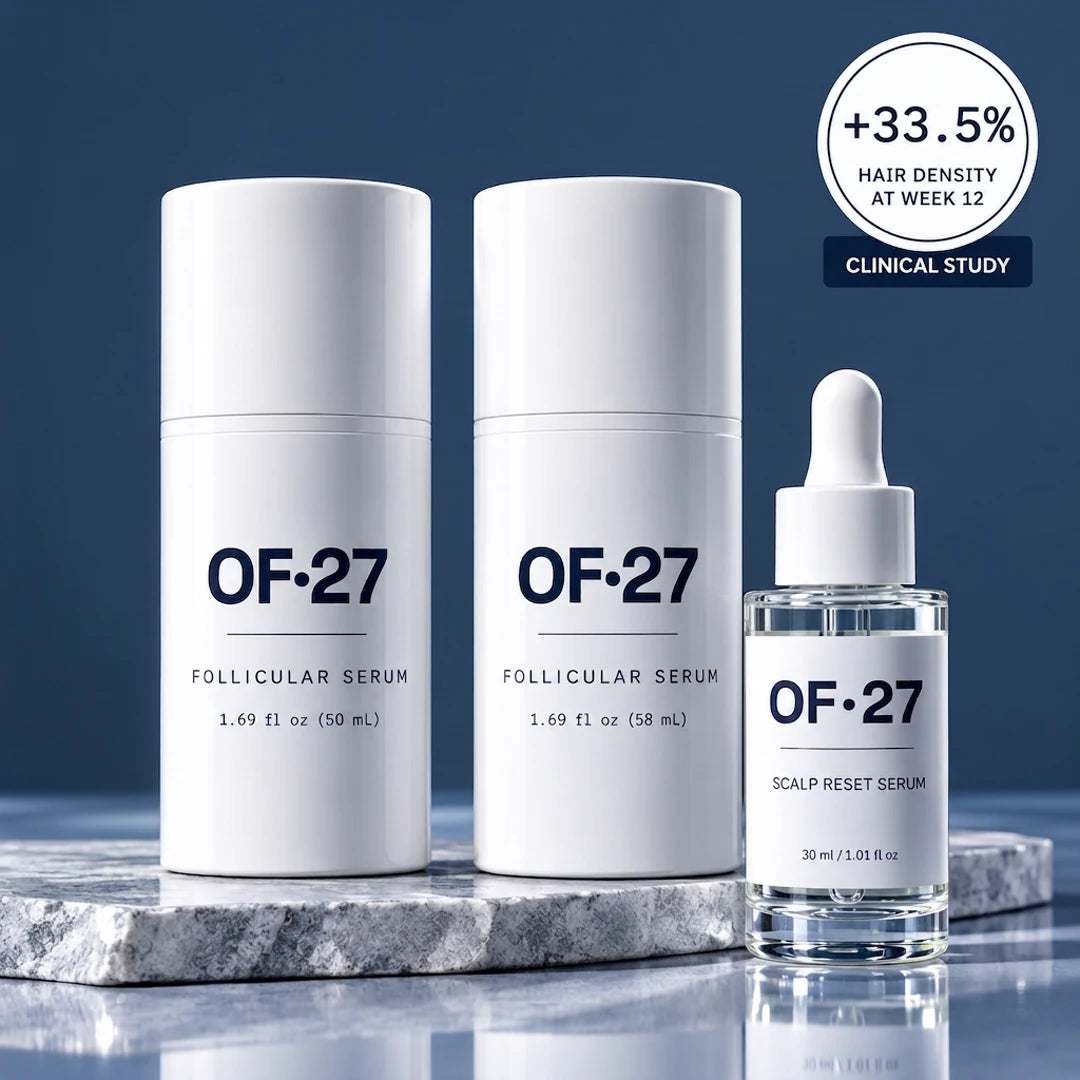
That's why OF·27 is a two-phase protocol, not a single product.
Phase 1 is the Scalp Reset Serum. A gentle exfoliant you use once or twice a week, left on for three to five minutes, then rinsed.
It clears the buildup between washes. Nettle leaf calms irritation. Hyaluronic acid restores moisture.
The purpose isn't cleansing. It's preparing the scalp for what comes next.
Phase 1 resets the surface. Phase 2 delivers the signal.
In the clinical study, the active group showed 22.2% better scalp hydration — less flaking, less tightness, a scalp that feels calm.
So the real question became: if you could keep a growth factor alive and deliver it to a prepared scalp — how much hair could you actually get back?
The answer required two signals, not one.
The first signal tells your follicle to wake up. It's the start-work order — the instruction that moves a resting follicle into active growth.
The second signal tells it what to build. Without this, a follicle may restart but produce a finer, thinner strand than the one it replaced. The second signal gives it the full construction plan.

A clinical scalp scan at week 12:
The group using OF·27's active ingredient saw 33.5% more hair density compared to where they started. The placebo group saw no meaningful change.
One signal restarts the follicle. A second tells it what to build.

Waking up a dormant follicle solves one problem. But if it starts growing without the right instructions, the strand it produces may be finer and shorter than the one it replaced.
That's why OF·27 carries both growth factors — one to restart the follicle, one to tell it what to build.
Both are carried inside the oleosome — a plant-based shell that keeps them alive from bottle to scalp.
The growth factor stays sealed inside its carrier. No water contact. No artificial preservatives. The shell is its natural home.
No fragrance. No silicones. No animal-derived ingredients. Natural, with no side effects.
OF·27 ships cold and stays in your fridge — the oleosome shields against water, but heat is the other enemy. Cold storage keeps the protein at full strength.
The routine is deliberately simple: one pump of serum, massaged into your scalp at night, left on overnight. No rinsing. No timing windows. No stacking with other products.
It absorbs without residue. No greasy, medicinal feel. That matters — because the product that works is the one you actually use every night.

By the study's endpoint, 17% more follicles were actively growing in the group using OF·27's active ingredient compared to placebo.
More follicles growing. Fewer resting. That's the shift — the morning you run your fingers through and something feels different.
~800 new hairs every night. ~23,000 in 28 days. The kind of number your barber notices before you do.
The clinical context
Here's the context most hair brands leave out.
The study was conducted on 40 participants experiencing diffuse thinning — the same pattern that affects adults as hormones shift with age. The data is yours.
We're not comparing ourselves to any other product. OF·27 was tested against its own placebo. We don't have data comparing it to minoxidil or any other treatment.
Here's what the clinical study measured after 12 weeks:
The placebo group saw no meaningful change.

Hair also grew 10.6% thicker in the active group over the study period. Not just more hair — hair you can feel between your fingers.
Together, the Scalp Reset Serum and the Follicular Serum form the complete OF·27 protocol.
Phase 1 prepares the scalp environment. Phase 2 delivers the signal.

What the next 12 weeks look like — and when you start to notice

Hair doesn't change overnight.
Here's what the study actually measured.

The Scalp Reset Serum begins clearing buildup and calming irritation. Your scalp starts to feel cleaner, less itchy, less reactive.
This isn't a hair result yet — it's preparing the ground.

This is where people start noticing less hair in the shower drain. Some see tiny new hairs sprouting around the hairline.
In just 28 days, that means 23,000 additional hairs on the scalp. That's close to 800 new hairs every night on your scalp.

This is where the study measured its results: 33.5% more hair density. Thicker strands. More follicles actively growing. Healthier scalps.
12 weeks is the endpoint the protocol was designed around. The goal is a photo you're not afraid to look at.
The scalp resets first. Then shedding slows. Then the density builds.
You check the mirror. You check the drain. You angle your head under every new light.
You tried biotin. You tried minoxidil. Then someone ran a real study.

We don't ask you to trust a brand name. We ask you to look at the data.
The clinical study was run by Abich S.r.l. — an independent laboratory in Verbania, Italy. 40 women with diffuse thinning. Placebo-controlled. 12 weeks.
The active ingredient was developed by Core Biogenesis — a French biotech laboratory founded in 2020 by Alexandre Reeber. They built the plant-based carrier system behind the product. OF·27 has secured exclusive access to this ingredient — no other brand in the world carries it.
"Independent clinical laboratory. 40 women. 12 weeks. Placebo-controlled. All four primary measurements showed statistically significant improvement in the active group."
"The team behind the active ingredient in OF·27. Five years developing the plant-based carrier system that keeps growth factors alive from production to application. OF·27 holds exclusive worldwide access."
"The carrier system behind OF·27 delivers growth factors intact — straight to the follicle. No other product on the market uses this exact formulation — because it cannot be assembled after the fact."
The science is public. The lab is independent. 12 weeks gives you that answer.
What customers say
In their own words. Nobody was paid for an opinion.

"I'm 62, wasn't expecting a miracle. But by week 8 the top of my head stopped catching the light the way it used to, and my hairdresser noticed new growth around the crown before I said a word. My hair looking like mine again."

"My part had been getting wider every year. By week 6 the shower drain was way less scary, and by 12 weeks the front was visibly thicker in side-by-side photos. Even my sister noticed on a video call. One pump at night and I'm done."

"Wasn't sure a serum would do much on a receding crown, but I stuck with it. By week 6 the top was almost fully back — not see-through under office lights, temples filling in. Barber noticed before I said anything. First thing in years that actually did what it said."

"The crown was what I was most concerned about. After consistent use, it looks less transparent in photos and under overhead lighting. Overall coverage is visibly better and my hair sits more naturally over the scalp. Gradual but convincing."

You're not adding a complicated step to your night. One pump, massaged in, left on while you sleep. That's the whole protocol.
The only question is whether what you put on your scalp tonight actually reaches the follicle alive.
If what you've read here makes sense, try the protocol for 12 weeks. If you don't see a real difference, the cost is ours — not yours.